
The AI candy cane trend and the cost of looking ‘better’
I’m all for a bit of cheesy fun. Last year for example, I hosted a wig party for friends.
And with all the heavy stuff happening in the world, we need moments of silliness and joy.
But the recent flood of AI candy cane glamour shots just didn’t sit right with me.
We’re used to seeing other festive photo trends. Like families in matching Christmas pajamas.
This one felt different.

Example candy cane portrait photo.
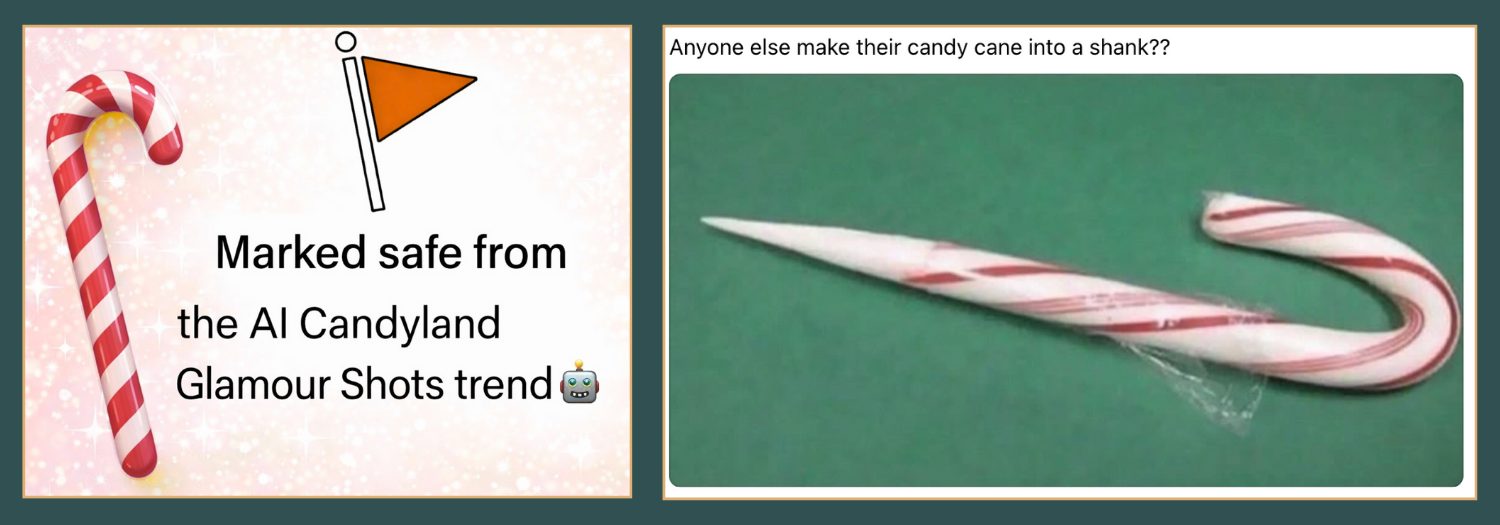
And here, some images that DID give me a chuckle 😂
The images were easy to generate. A single prompt. A polished, candy cane fantasy version of yourself. And suddenly my feed was filled with near-identical portraits of glossy perfection.
And the more I saw, the more uncomfortable I felt.
As a bigger person, I understood how this tool would shrink me into something more palatable. And transform me in a way that would be so drastically different from who I am in reality right now. I knew that it would feel… ridiculous, conforming, negative.
Of course, AI doesn’t create in a vacuum. It reflects the values embedded in the data it’s trained on. And we already know those systems carry bias. Around bodies. Around gender, race, age, sexual orientation, class, disability. Around what is considered beautiful, professional, or acceptable.
I came across a Facebook thread about using AI-generated portraits for personal brands, and a few comments really stuck with me:
“It almost always makes me look whiter.”
“I’m a larger lady and they always slim me down, which should feel nice, but what it is actually saying is you are not socially acceptable the way you are. Also it doesn’t seem to like curly hair, as it gives me a blow out 😂. I’m a proud curly girl.”
Not cool!
Eroding trust and erasing ourselves
There’s a difference between lightly editing a real photo and generating a new, idealized version of yourself from scratch. And if you do, it’s best to disclose that it’s AI. Otherwise it can make your audience feel manipulated. And that erodes the trust we work so hard to build as business owners.
Here’s another comment I saw on the candy cane trend:
“It isn’t a trend, it’s the damn homogenizing handmaids tale with silver dresses… Dress up, go out, live a life, take pictures of that. Be different, wavy, eccentric, unique, unpredictable, original.”
Harsh? Maybe.
But I do agree that trends and tools like these can flatten dimensions of human uniqueness and beauty. They can make us feel bad about ourselves, and take us back as women.
If you posted an AI photo, I’m not here to shame you. Truly. We’re all navigating new tools in real time, without a clear rulebook.
But I do think it’s worth asking the question:
Are we losing ourselves and what makes us human? Are we stripping away our sense of self worth?
AI is not the problem – it’s figuring out how to use it responsibly.
Certainly, these are complex topics and I’m always open to hearing how you are thinking about it.
